

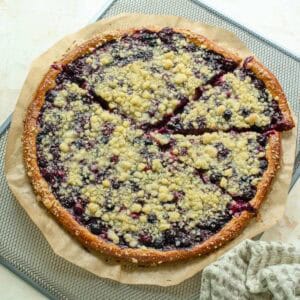
Imagine the biggest kolache you have ever seen: a thin yeasted crust, a thick layer of fruit, and a blanket of buttery streusel on top. That is frgál, the pride of Valašsko (Wallachia), a hilly region in eastern Moravia. Some of my American readers call it a sweet pizza pie, and the name fits better than you might think.
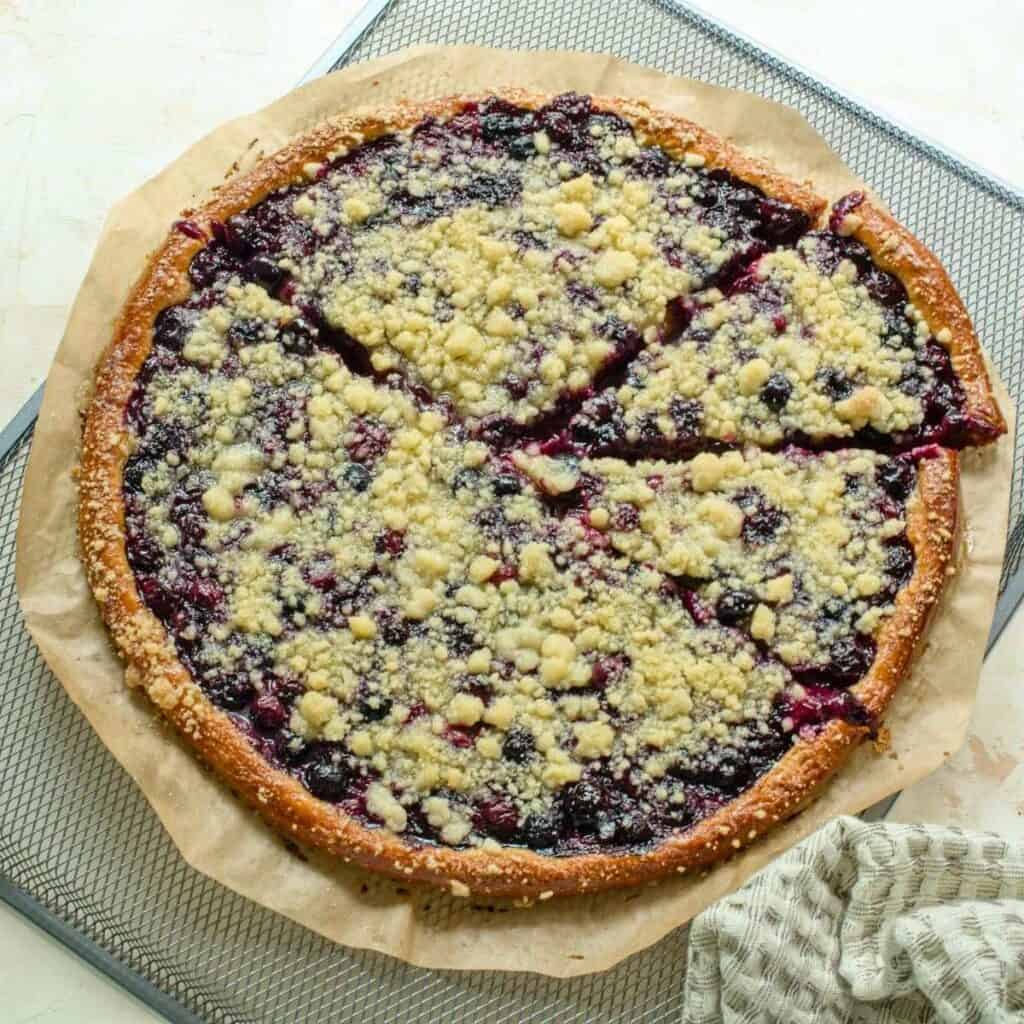
What is Wallachian frgál? Frgál is a large, round Czech pastry: a yeast dough rolled out thin, about 12 inches (30 cm) across, spread with one sweet generous filling, in this case blueberries, sprinkled with streusel, and brushed with melted butter and rum the moment it comes out of the oven.
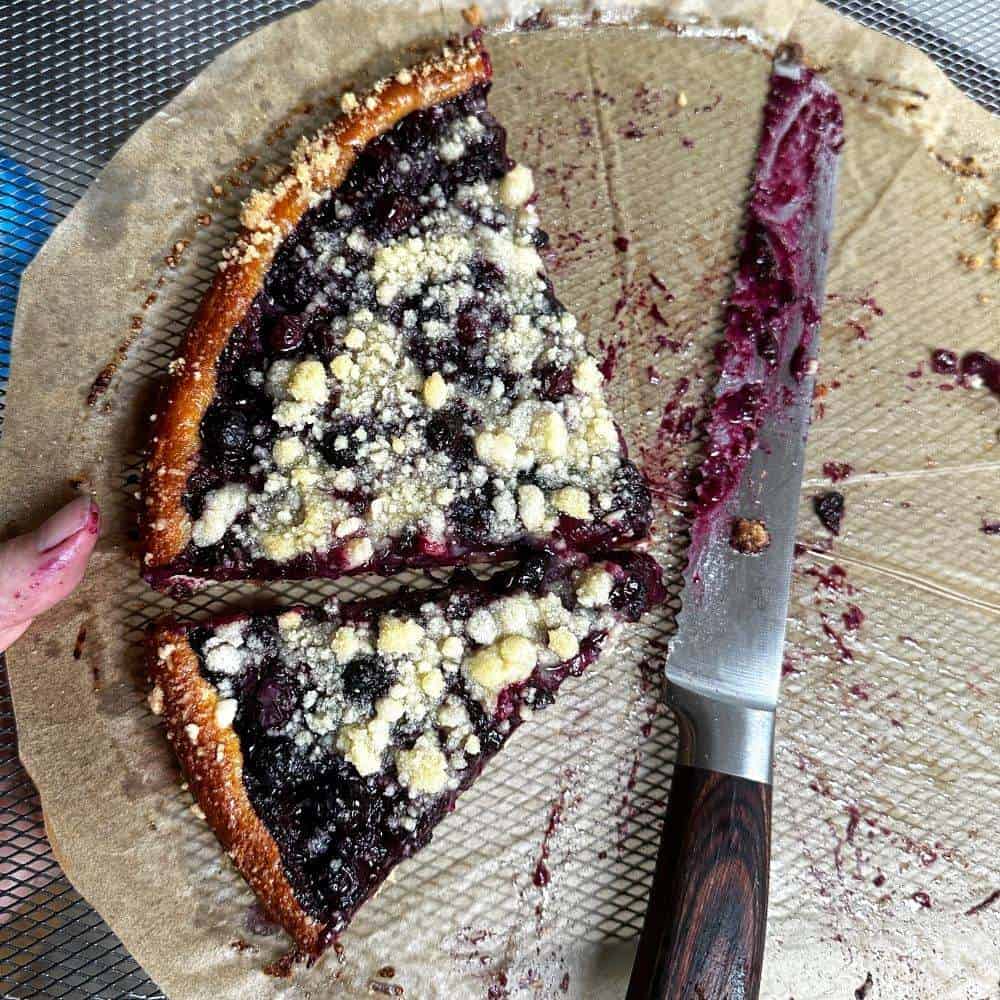
Making frgál takes about 2.5 hours, including rising time. Czechs cut frgál into wedges and serve it with coffee. I come from Bohemia, while frgál is a Moravian specialty, so I bake it whenever I want to change up my usual round of traditional kolaches. By now I roll out that thin dough with complete confidence, and once you learn the technique, it does not matter which filling you put on top.
Jump to
➜ Two tips on this recipe
- Roll the dough thin, but not paper-thin as you would for stretched strudel dough. For frgál, it needs to support a heavy layer of fruit, so if you can see the countertop through the dough, it is too thin and may tear or bend.
- Brush the hot frgál with the butter and rum mixture as soon as it comes out of the oven. This is not just for flavor: the mixture soaks into the crust, adds a rich buttery aroma, and helps keep the frgál fresh longer.
" I am from Wallachia and frgál with fresh blueberries is the best one."
Pavlína
Frgál began as a festive bake, and in the Czech Republic, especially in Moravia, you find it all year round at bakeries, fairs, and folklore festivals. If you live abroad, it is also a lovely way to share your Czech roots when friends are coming over and you want to put something truly Czech on the table. If you enjoy Czech yeasted pastries, try the round double-filled Moravian kolaches (moravské koláče), their folded cousins tied kolaches (šátečky), or a rectangular blueberry yeast coffee cake next.
➜ The story behind Wallachian frgál
Like more than one famous dish, frgál started as an insult. In the Wallachian dialect, frgál was the word for a botched vdolek (a round, flat yeasted pastry): one that tore, spilled its filling, or fell on the way to the oven. Old-timers remembered that no baker wanted to hear her pastries called frgály. Other nicknames are friendlier: lopaťák, from lopata (a shovel), because the pastry is as big as one, and pecák, from pec, the wood-fired oven it was baked in.
The first written mention of frgál dates back to 1826. The Wallachian vdolek then stepped into the spotlight at the Ethnographic Exhibition in Prague in 1895, and during the first half of the 20th century it moved from farm kitchens into bakeries across Wallachia. By the end of the century, the once-mocking name frgál had stuck, and the pastry had won over the whole country.
Since 2013, Wallachian frgál has been protected by the European Union as a regional specialty with strict rules: a certified frgál measures 12 to 12.5 inches (30 to 32 cm) across, stands no taller than ¾ inch (2 cm), and the filling makes up 42 to 48 percent of the whole pastry. In other words, almost half of every bite is filling.
My favorite piece of frgál lore comes from the village of Nový Hrozenkov, where housewives once baked a special strakatý frgál (a "spotted frgál") decorated with dabs of every filling in the house. It was not for the family: it went to the cows on Christmas Eve, so they would give birth to spotted calves.
When Moravians emigrated to America in the 1800s, many settled in Texas, where their descendants keep the baking tradition alive. One of my readers remembered picking wild dewberries for her mom's pizza kolaches by the Texas railroad tracks, wearing boots and long sleeves, with a snake stick to beat the grass.
Czech pronunciation
The word frgál looks short, but the Czech rolled r gives English speakers a little workout. Say it FUR-gaal, with the stress up front and a long aa in the second syllable. The full name, valašský frgál, sounds like VAH-lush-skee FUR-gaal. Click and listen to my audio clip, and you will hear both spoken by a real Czech.
➜ Ingredients you will need
✅ See the recipe below with step-by-step photos and many helpful tips. Scroll down for the full printable recipe in both US cups and metric measurements.
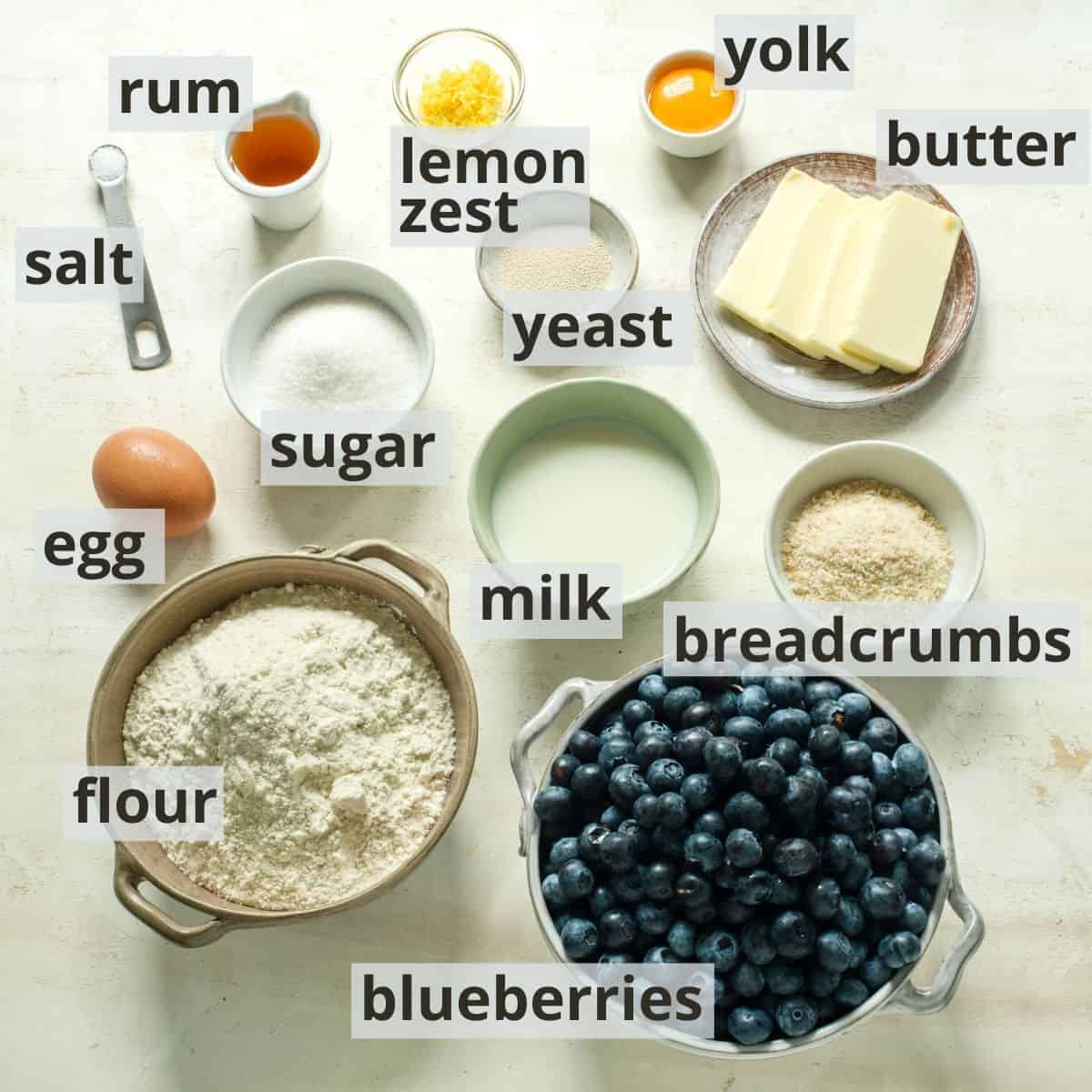
- All-purpose flour, the base of the dough and the streusel. In the Czech Republic I bake frgál with hladká mouka; all-purpose flour is the right match abroad.
- Active dry yeast, the leavening. Frgál dough is rich with butter, so it needs a full and lively rise.
- Milk, lukewarm, to wake the yeast up.
- Unsalted butter, three times over: melted into the dough, rubbed into the streusel, and mixed with rum for the final glaze.
- Egg yolk, to enrich the dough. You will also need one whole beaten egg for brushing the rim before baking.
- Granulated sugar, for the dough, streusel and over the blueberries.
- Lemon zest, grated fresh.
- Blueberries, the star of this frgál. Czech forests are full of borůvky, which are in fact European bilberries: smaller, darker, and tarter than cultivated blueberries, with a juice that stains your teeth purple. Store-bought blueberries work beautifully, they are just milder and sweeter, so taste before you add the sugar.
- Plain breadcrumbs, a thin layer under the berries that soaks up their juice.
- Streusel (posypka, as it is called in Wallachia), a simple mix of flour, butter, and sugar.
- Spiced rum, for the signature glaze. Czechs use tuzemák, our spiced-rum-style spirit; abroad, reach for Austrian Stroh or a spiced rum like Kirkland brand.
Equipment
- Flexible plastic dough scraper (affiliate link) - My favorite tool for handling soft yeast dough.
- Small rolling pin (affiliate link) - For better control when rolling the dough.
- Round parchment paper (affiliate link) - For easy shaping and transferring.
➜ How to make Wallachian frgál
STEP 1: Activate the yeast. Pour ¼ cup of the lukewarm milk into a small bowl, stir in 1 teaspoon of the sugar and the yeast, and set the glass in a warm, draft-free spot for 10 to 15 minutes, until foamy.


Lukewarm means a drop on your wrist feels barely warm; yeast is a living thing, and anything hot would kill it. It is worth checking the expiration date on the yeast before you start.
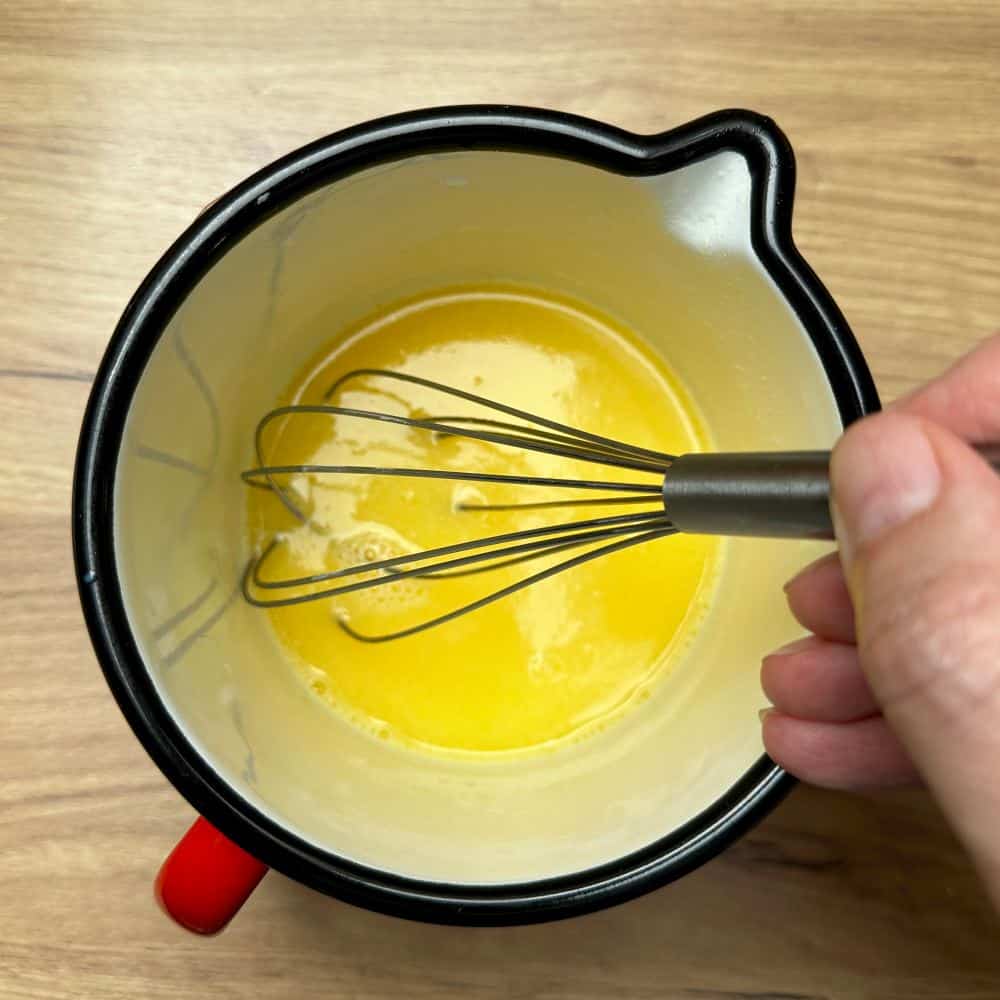
STEP 2: Mix the wet ingredients. Melt the butter in a small saucepan and take it off the heat to cool a bit. Pour in the remaining milk, which cools the butter down. The mixture must not be hot; lukewarm or even nearly cool is fine, only heat can harm the yeast. Whisk in the egg yolk.
STEP 3: Mix the dry ingredients. Put the flour, powdered sugar, salt, and lemon zest into a large bowl and stir them together by hand.
STEP 4: Bring the dough together and knead. Make a well in the middle of the flour, pour in the foamy yeast and the wet mixture, and combine roughly with a fork.
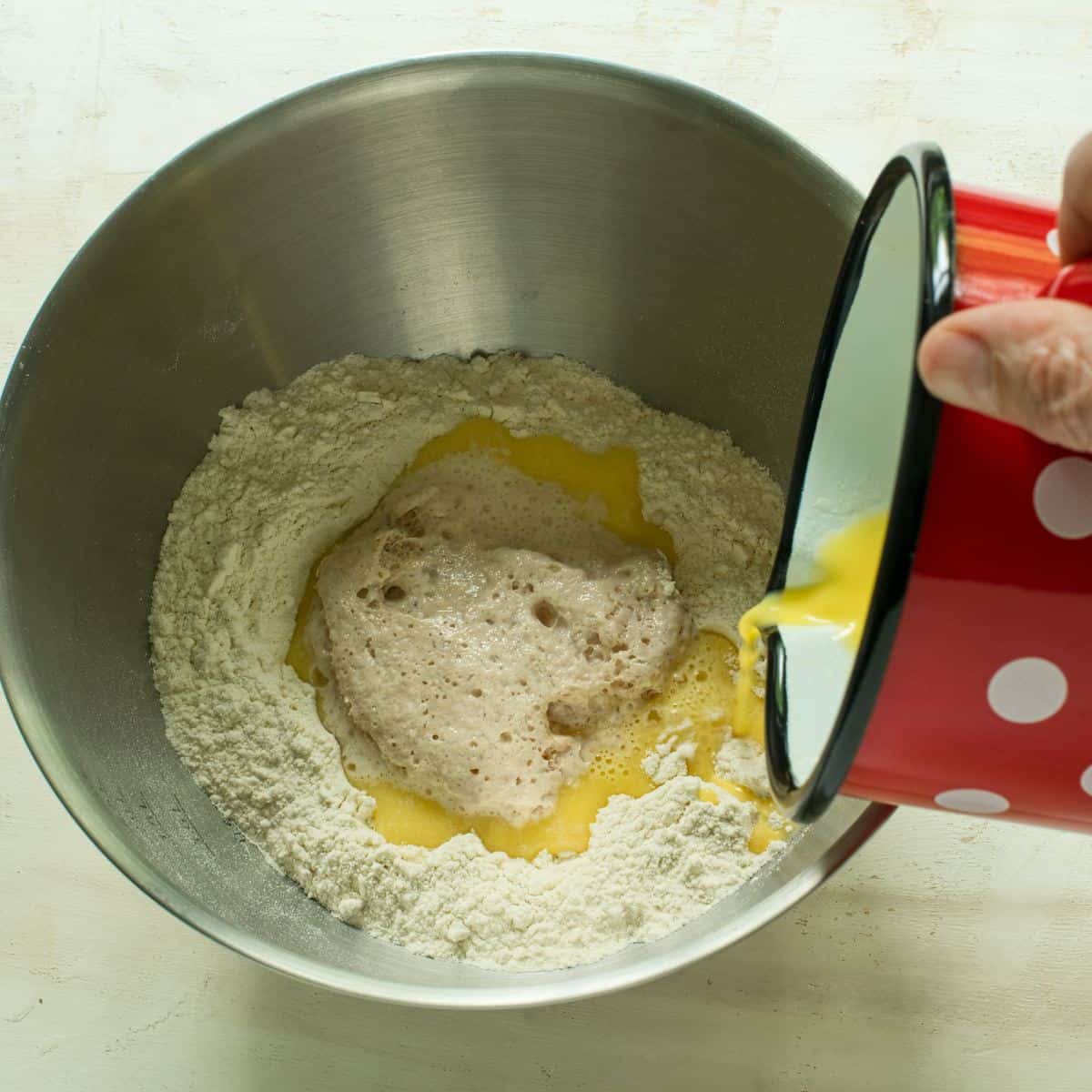
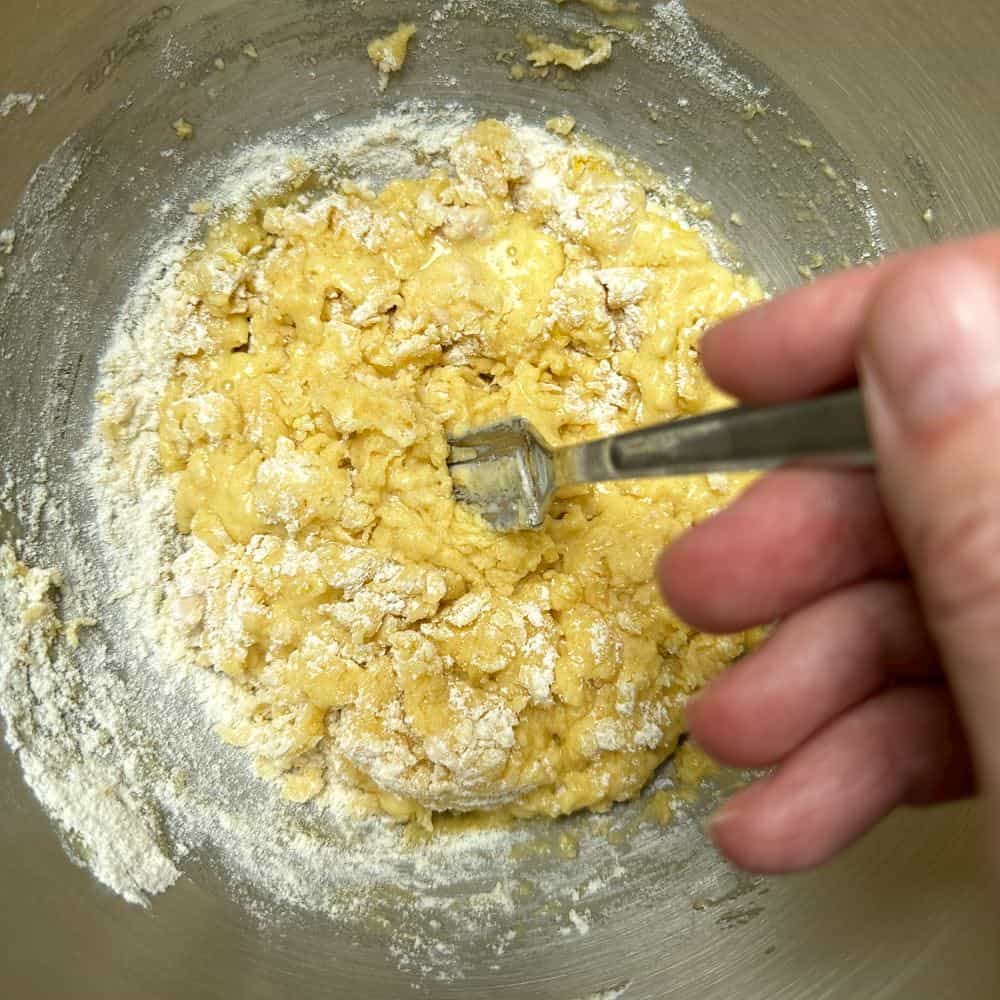
There are three common ways to knead the dough, and a stand mixer is the easiest. With the dough hook, run the mixer on the lowest speed for 1 to 2 minutes, then on medium-low for about 8 minutes. The heritage way is to beat the dough in the bowl with a wooden spoon (vařečka) until it no longer sticks to the spoon and small blisters appear on the surface. Kneading by hand takes about 10 minutes on a floured board.
Whichever way you choose, the dough is ready when it is smooth, elastic, and sticks to your fingers only a little. It should stay soft and slightly tacky, not runny.
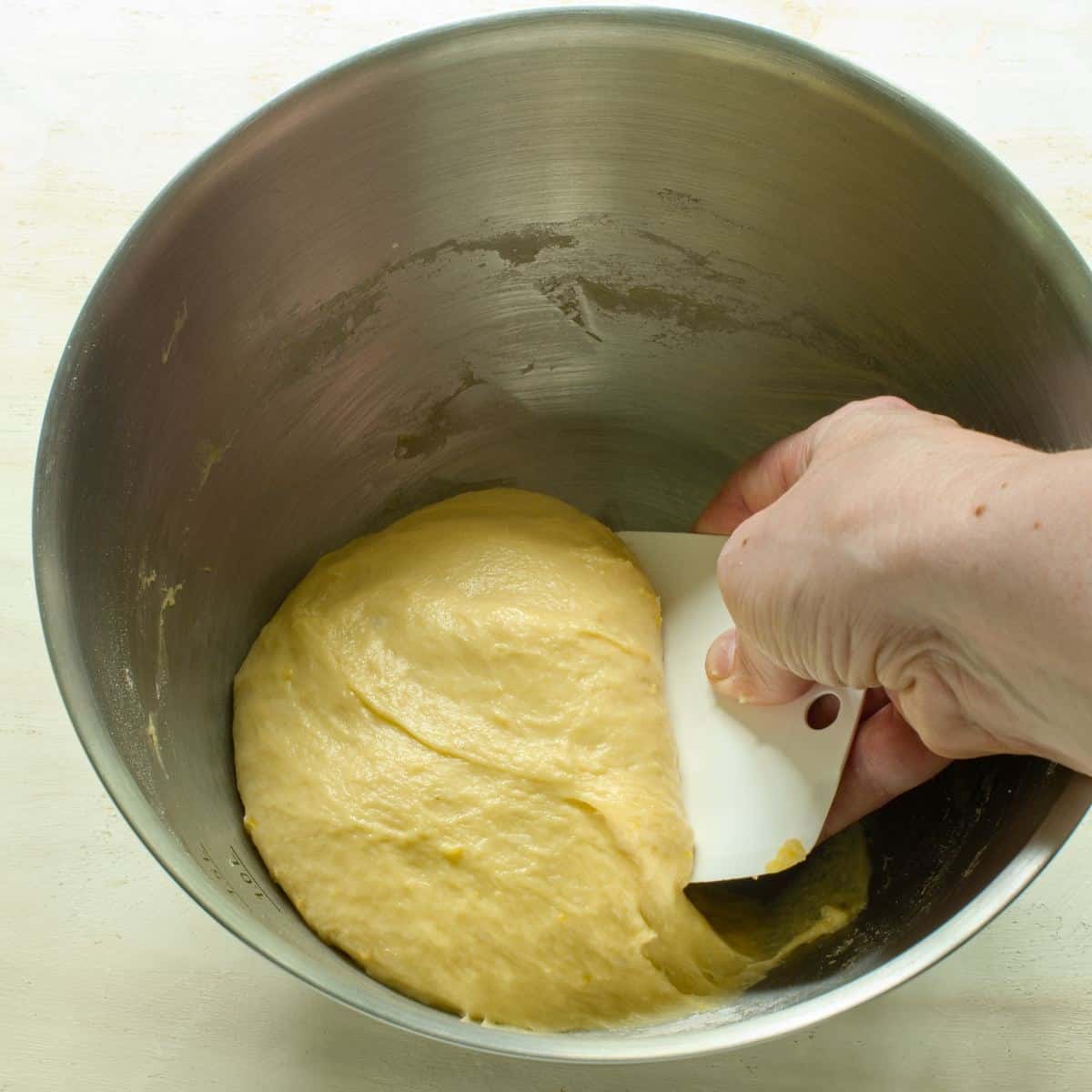
A flexible plastic dough scraper (affiliate link) is the best tool for handling the dough.
STEP 5: Let the dough rise. Cover the bowl and leave it in a warm, draft-free place for about 1 and ½ hours, until doubled; frgál dough is rich with butter, so it rises slower than a lean dough.
If your kitchen is air-conditioned and cool, use an enclosed spot, or try my trick for letting dough rise in the oven.


STEP 6: Make the streusel while the dough rises. Put the flour, sugar, and butter in a bowl, then rub the mixture between your fingers until crumbs form. Keep the streusel in the refrigerator until you need it; it firms up nicely in the cold.

STEP 7: Divide and rest. Turn the risen dough out onto a floured board, knead it briefly, and split it into two equal buns. Shape each into a ball, seam-side down. Cover them with a towel and let them rest for about 15 minutes.
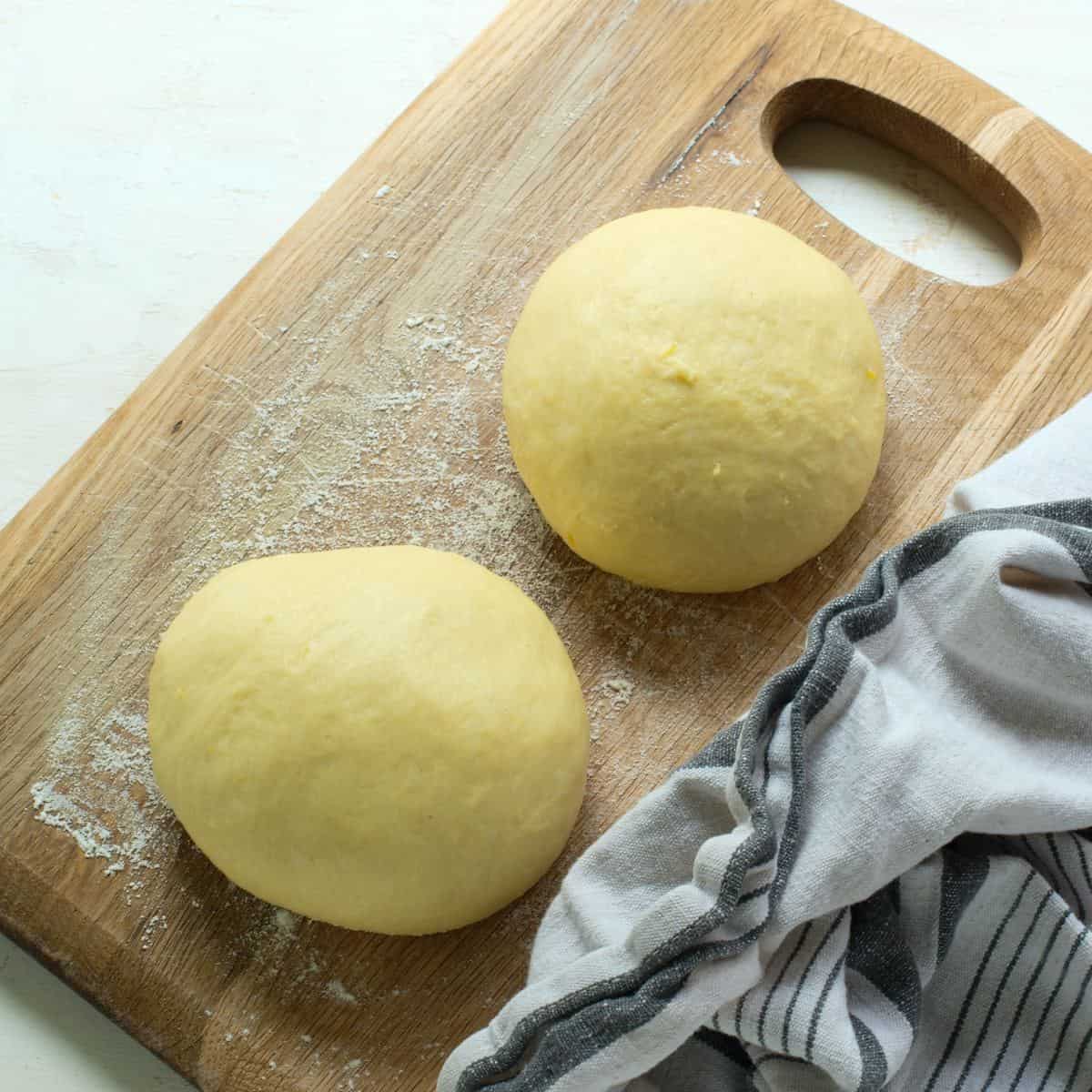
STEP 8: Roll out the dough. Cut a piece of parchment paper into a circle about 12.5 inches (32 cm) across; the round paper will guide you to a round frgál. Grease the parchment paper with a little butter and sprinkle it lightly with flour.
Place one ball of dough on the parchment and roll it out to a circle about 12 inches (30 cm), staying just inside the paper's edge, thin but still sturdy. Help yourself with your fingers (my favorite method) to shape the edge into an even round.
Shape a low rim about ½ inch (1 cm) high around the edge, then brush it with the beaten egg.
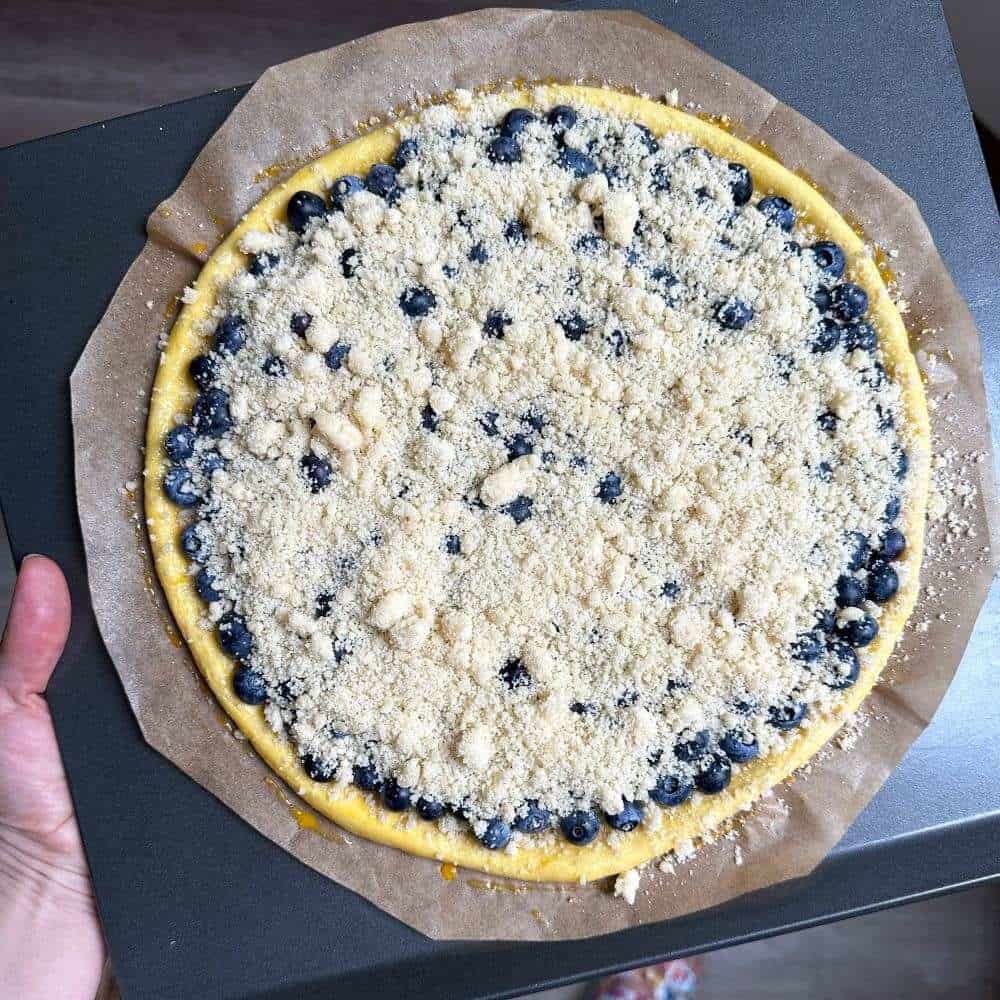
STEP 9: Fill and top. Sprinkle half the breadcrumbs thinly over the dough. Spread the blueberries on top, starting at the rim and working toward the center. Sprinkle them with sugar to taste; about 2 Tablespoons per frgál is usually right, less if your berries are sweet. Cover the fruit generously with streusel and let the frgál rest for 15 minutes while the oven preheats.
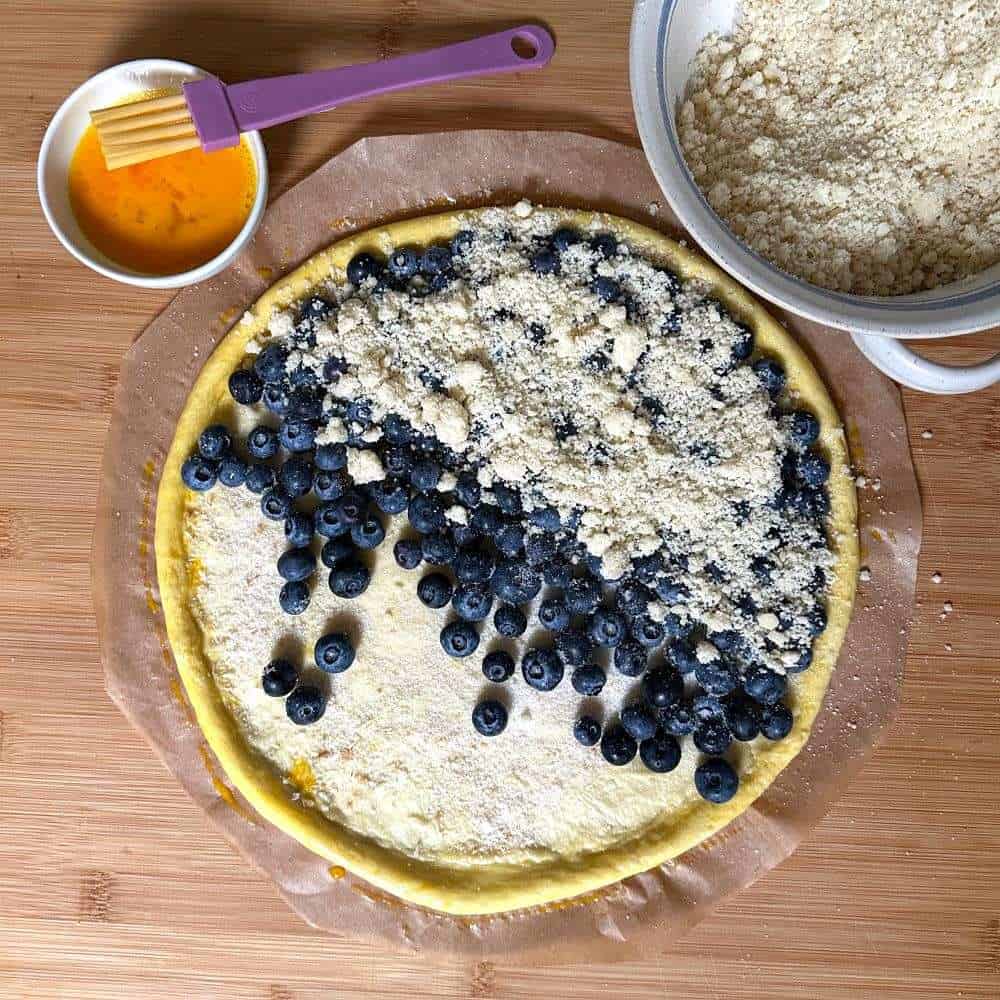
STEP 10: Bake. Carefuly slide the frgál, still on its parchment, onto a baking sheet. Bake at 380 °F (190 °C) for about 20 minutes.
After about 12 minutes, lift the edge with a spatula and check that the bottom is coloring. The center bakes slower than the rim because of the thick filling, so if the edges brown too quickly, cover the frgál loosely with aluminum foil.
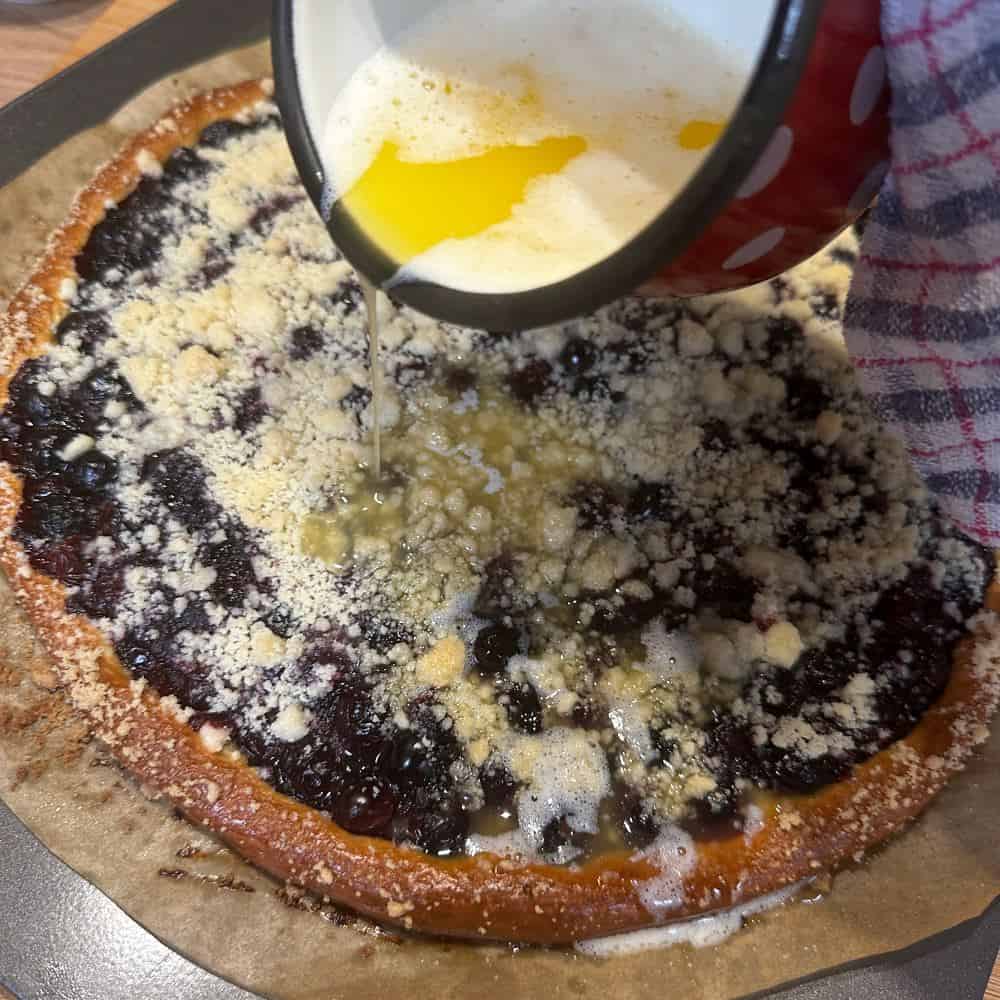
STEP 11: Splash with butter and rum. While the frgál bakes, melt the butter in a small pot and stir in the rum. The moment the frgál comes out of the oven, brush or splash the hot surface with about half the mixture, rim and center alike.
Then roll out, fill, and bake the second frgál the same way.
➜ Traditional frgál fillings
- Dried pear filling, the oldest and best-known. Ground dried pears, never fresh ones, which hold too much water; the filling is dark, dense, and honeyed.
- Tvaroh filling, creamy and gently sweet. My tvaroh cheese filling recipe works for frgál without any changes.
- Poppy seed filling, ground poppy seeds cooked in milk; follow this poppy seed filling recipe.
- Plum butter filling, thick and tangy; here is my plum butter filling (povidlová náplň).
- Sweet cabbage filling, a surprise for most non-Czechs; my sweet cabbage filling comes from the same vintage tradition. Wallachian bakers also fill frgál with ground walnuts, grated carrot, and once upon a time even potatoes!
If frgál has won you over, try Chodské koláče next: a western Bohemian relative of frgál. Chodské koláče are made in much the same way and are about the same size, but they are famous for their decorated tops, with several fillings arranged in beautiful patterns.
➜ How to serve Wallachian frgál
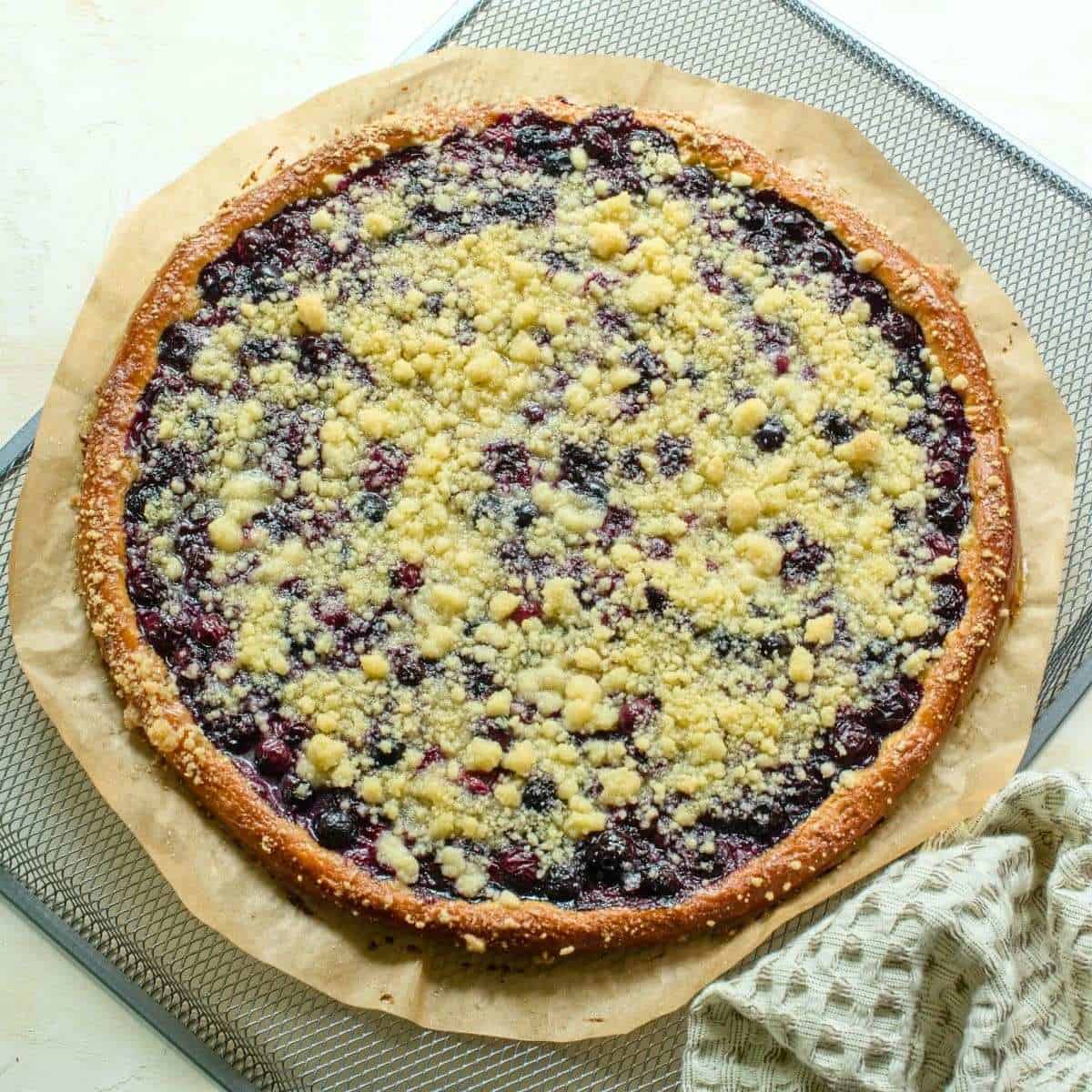
Serve frgál at room temperature. It needs no plate dressing: no whipped cream, no dusting of sugar, the butter and rum glaze is the finish.
At markets you can even buy a mixed frgál, assembled from differently filled wedges, so nobody has to choose just one filling. Dobrou chuť!
➜ How to store frgál
- At room temperature: frgál tastes best within the first 2 days. Keep it covered so it does not dry out.
- In the refrigerator: wrapped or in an airtight container, frgál keeps for about 5 more days.
- Freezer: frgál freezes very well; certified Wallachian bakeries store it frozen for up to 9 months. Wrap the whole frgál or individual wedges tightly before freezing.
- Thawing: let frgál thaw slowly at room temperature, never in the microwave, and enjoy it within a day of thawing.
➜ FAQ
Mainly the size and the ratio. A classic Czech kolache is a palm-sized pastry with a circle of filling in the middle. A frgál is a 12-inch (30 cm) giant kolache, rolled thin, where the filling makes up nearly half the weight.
Frgál is Moravian. It comes from Wallachia (Valašsko) in eastern Moravia. We Bohemians bake different kinds of kolaches instead and usually enjoy frgál when we visit Moravia or spot it at a market.
Yes, and do not thaw them. Thawed berries release too much juice and soak the thin dough. Toss the frozen blueberries with a spoonful of flour, scatter them over the dough, and send the frgál straight into the preheated oven. The breadcrumb layer under the berries catches any extra juice.
On a hot frgál, the butter and rum soak deep into the pastry. Some Wallachian bakers pour the mixture only after the frgál cools completely, so it forms a thin, glossy coat on top instead. Both ways are traditional; I am firmly in the hot camp.
Tried this recipe?
Leave a review down in the comments! ⭐⭐⭐⭐⭐
Other readers and I love hearing what you think. Stay in touch by following me on Facebook and Pinterest. For more Czech stuff, subscribe to my newsletter!
📖 Recipe
Wallachian Frgál with Blueberries
Tap or hover to scale
This recipe was developed in grams. For the most accurate results, tap the purple METRIC toggle and use a kitchen scale.
Ingredients
For the dough
- ½ cup milk lukewarm, divided
- ¼ cup granulated sugar divided
- 2 teaspoon active dry yeast
- 6 Tablespoon unsalted butter
- 1 egg yolk
- 1 ¾ cup all-purpose flour
- ¼ teaspoon salt
- 1 Tablespoon lemon zest freshly grated
For the posypka topping
- 1 ¼ cup all-purpose flour
- ½ cup granulated sugar
- 8 Tablespoon unsalted butter
Plus
- 1 egg beaten, for brushing the rim
For the filling
- 4 Tablespoon fine breadcrumbs unseasoned
- 5 cup blueberries fresh
- 4 Tablespoon granulated sugar
For the rum and butter topping
- 6 Tablespoon unsalted butter
- 3 Tablespoon spiced rum Czech tuzemák or Austrian Stroh
Instructions
- Pour half of the lukewarm milk into a bowl, stir in 1 teaspoon of the granulated sugar and 2 teaspoon active dry yeast. Let it sit in a warm place for 10 to 15 minutes, until foamy.
- Melt 6 Tablespoon unsalted butter in a small saucepan and take it off the heat to cool a bit. Stir in the remaining milk; the mixture must not be hot. Whisk in 1 egg yolk.
- Combine 1 ¾ cup all-purpose flour, remaining sugar, ¼ teaspoon salt, and 1 Tablespoon lemon zest in a large bowl.
- Make a well in the middle, pour in the the foamy yeast and the wet mixture. Roughly combine with a fork so it comes together. Knead until the dough is smooth and elastic, about 8 minutes with a dough hook on medium or 10 minutes by hand. The resulting dough should stay soft and slightly tacky, not runny.
- Cover the bowl and let the dough rise in a warm place for about 1 and ½ hours, until doubled.
- For the streusel, rub 1 ¼ cup all-purpose flour, ½ cup granulated sugar, and 8 Tablespoon unsalted butter between your fingers until crumbs form. Refrigerate until needed.
- Turn the dough out onto a floured board, knead it briefly, and divide it into balls of about 8.5 oz (250 g) each; the base recipe makes 2 frgály. Cover and let rest for 15 minutes.
- Working with one ball at a time, roll it out with a rolling pin or your fingers on a round piece of parchment paper, lightly greased and floured, into a circle about 12 inches (30 cm) across. Shape a low rim about ½ inch (1 cm) high around the edge, then brush it with 1 egg, beaten ahead with a fork.
- Sprinkle the dough with 2 Tablespoons of the breadcrumbs. Spread about 2 ½ cups (360 g) of the blueberries on top, starting at the rim and filling in toward the center. Sprinkle with about 2 Tablespoons of the granulated sugar, and cover with an equal share of the streusel. Let the frgál rest for 15 minutes while the oven preheats to
 380 °F.
 - Bake for about 20 minutes. After about 12 minutes, lift the edge with a spatula and check that the bottom is coloring; if the edges brown too quickly, cover the frgál loosely with aluminum foil.
- Melt 6 Tablespoon unsalted butter for the topping and stir in 3 Tablespoon spiced rum. As each frgál comes out of the oven, drizzle it generously with an equal share of the mixture.
- Roll out, fill, and bake the remaining frgály the same way.
Notes
- Two frgály: the basic recipe makes two 12-inch pastries. Divide the breadcrumbs, the filling, the streusel, and the butter and rum mixture in half, one half per frgál.
- Oven: temperatures are for a conventional oven; for convection, lower by 25 °F.
- Edges: the rim bakes faster than the fruit-covered center, so wait the full 20 minutes and shield the edges with foil if they brown too quickly.
- Frozen blueberries: do not thaw them. Toss with a spoonful of flour and add straight from the freezer; the breadcrumb layer catches the extra juice.


Matt Erdman says
Hello Petra,
My mother's family immigrated to the United States from what is now Czechoslovakia in the 1800's. We still have family in Bílov. When I was young, my grandmother made frygály, which she called kolache. Since she passed away in the nineties, I've continued to make these traditional desserts for my family on holidays, but I've never been able to get the crust right; it always rises too much or too little. Thank you for posting your recipe. Every year there is more information online, and that's how I found out that this style of pastry is called a frygál. With help from you and others, I will eventually make this dessert as well as my grandma did.
Best of luck with your online venture!
-Matt
Petra | Cook Like Czechs says
Ahoj Matt,
thank you very much for you comment, as I checked Bílov is a nice town in the North Moravia. Have you ever been there?
Once I had a holiday near there with my family and the surrounding is pretty impressive – both wonderful nature and industrial feeling (Ostrava above all). Especially my boys loved it! 🙂
About frgály: This is a specialty of Moravian housewives, we in the Bohemian part of the Czech Republic can only be envious. We only make kolaches here, which are smaller and not so „rum-smelling“ like a real frgál.
Frgál is bigger than the normal kolach and is about 12 inches in diameter. The dough is very thin, but there is plenty of filling on it.
Crossing my fingers that your next try will turn out exactly how your grandmother used to bake.
Enjoy your Christmas time,
many greetings from the Czech Republic, Petra 🙂
Beck says
Petra, I am going to make this on the recommendation of a Czech friend from the Olomouc area. What would be the best oven temperature to make sure the dough cooks evenly on the edges and under the filling?
Děkuji!
Petra says
Hi Beck, bake frgál at 380 °F (190 °C) in a conventional oven. The rim always finishes before the center, because the thick layer of fruit and streusel keeps the middle moist longer. After about 12 minutes, lift the edge with a spatula to check that the bottom is coloring, and if the rim browns too quickly, cover the frgál loosely with aluminum foil. Give it the full 20 minutes and the dough will bake through evenly. Hope this helps!
Steve says
you wrote there "340 °C (170 °C)", first C instead of F
Petra Kupská says
Hi Steve, thank you for your sharp eye, you are right, that should have read 340 °F. In July 2026 I reworked the whole recipe from the ground up, and the updated version now bakes at 380 °F (190 °C), with the temperatures written correctly. I appreciate readers like you who help me keep the recipes accurate! Greetings from Bohemia, Petra
Ann Kottal says
My father’s family came from Bohemia in the late 1800s. They finally settled in Kansas. I can remember my grandmother making some of your recipes….most that I loved and a few that I said no than you to! I’m about to try this frugal in hope that it will solve my problem with the filling sliding off the kolache when I try to make them. I love your recipes as they are so straightforward and the photos show just what you need to do. Wish me luck on my frugal!
Petra Kupská says
Good luck, Ann, though I do not think you will need much of it! The frgál is kinder than kolache here, because the filling spreads over the flat dough and there are no wells for it to slide out of. And for your kolache: let the dough balls finish their final rise, press the wells deeper than you think, and do not overfill, a thicker filling holds its shape best. You can do this!
Anthony Machacek says
Just you know, Valacien frugal is not made with blueberries but with dry pears filling
Petra Kupská says
Ahoj Anthony, thank you for your comment. You are right, Wallachian frgals are often filled with dried pears (called pracharanda in Czech). However, it is not the only type of frgal-filling. Poppy seed, tvaroh (farmers’ cheese), and plum fillings are also popular. Blueberries are less common, but they are certainly one of the fruits that can be used. It also depends on the region where the frgals are baked and the season - fresh wild blueberries can be picked until about mid-summer when they grow abundantly in the Czech forests.
Cherry Chapman says
Hello Petra!
Bravo, and thank you for your excellent recipes and your son for his wonderful English translations!
I am an American living in Paris, France who loves to try different recipes from various countries.
I look forward to trying the Frgály as splashing the tart with butter and rum sounds unusual and delicious.
Easter Blessings to you and your family.
Petra Kupská says
Ahoj Cherry, thank you very much for your lovely comment! 🙂 Frgals are an excellent choice. They taste delicious, and besides blueberries, frgaly cakes can be filled with poppy seeds, thick pear jam, or cream cheese filling. The trick to drizzle them right out of the oven with melted butter mixed with rum is brilliant. I also use this method for small wedding cookies: I dip them still hot in a mixture of butter and rum and quickly coat them in icing sugar. Give it a try and I'll love it if you let me know how it turns out! Best wishes to Paris from Bohemia, Petra
Monica Frydl says
Petra,
In the ingredients list, there is yolk. However I noticed that it is not mentioned in the cooking instructions. Later the instructions say to use an egg to brush the dough, is this where you use the yolk?
Petra Kupská says
Ahoj Monica, thank you very much for your sharp eye! The egg yolk is added to the yeast dough when made, I forgot to mention that in the instructions. Thanks again you noticed!
Kimberly says
Hello
I would like to try making this. When you make the strudel mix, should the butter be cold or room temperature?
Petra Kupská says
The streusel, or posypka as we call it in Czech, works best with butter that is chilled but not rock-hard: take it out of the fridge a little while before you start and rub everything together with your fingers. Once mixed, the streusel can wait in the refrigerator until you need it; it firms up nicely in the cold. Happy baking!
Ray says
aye good day Petra I really enjoy your recipes I live in Tennessee in the USA have some knowledge of polish recipes and a lot of southern cooking experience I see similarities with your formulas and polish recipes I grow a lot of my food here on homestead so I cook with what I have on this recipe I used the homemade blueberry pie filling that I canned because that is what I have in my pantry it was excellent I rolled out the dough with a large lip as to hold my filling and topped with the strudel after baking and put back in the oven to brown I am planning on freezing more of my blueberries harvest this year but im limited on freezer space again thanks for sharing your time and recipes 👍👍👍👍👍👋🙏
Petra Kupská says
Thank you, Ray, for your nice comment! The cuisines of the Czech Republic and Poland have a lot in common, plus both countries are also neighbors 🙂
Rachael says
My store didn’t have fresh blueberries; can I use frozen? If yes, would I bake the crust then add the filling?
Petra Kupská | Cook Like Czechs says
Hi Rachel, frozen blueberries work well, just do not thaw them; toss them with a spoonful of flour and scatter them over the dough straight from the freezer. No need to pre-bake the crust: frgál always bakes with the filling on the raw dough, and the breadcrumb layer underneath catches any extra juice. I am sure your frgál will turn out beautifully. Dobrou chuť!
Steve says
My Czech mom would have been proud of me! Great recipe. Thank you so much. Very yummy. I’ll definitely make this again and again.
Petra Kupská | Cook Like Czechs says
You are very welcome! 🙂 I am so happy to hear it turned out well and I am glad you enjoyed it!
Elaine Freemal says
My mother-in-law made this often, but with fresh strawberries. I'm so glad to
see this recipe as she never shared most of her recipes with me, and this was
one of them.
Petra Kupská says
I am glad this recipe struck a chord with you. Strawberries sound lovely on a frgál too, so feel free to bake it her way. I hope it tastes just like you remember!